Republic of Zambia | Ministry of Education
info@zls.gov.zm

Zambia Library Service

Providing Knowledge, Innovation and Information Access Across Zambia

Ministry of Education
Welcome
Welcome to the Zambia Library Service Publications Portal! Explore official Ministry of Education publications, government policies, reports, manuals, strategic plans and research documents. Promoting access to knowledge, information, education and national development. Discover available publications and access documents through the Zambia Library Service.
Knowledge and Information Resources

Publications Library

Welcome to the Zambia Library Service Publications Library. This portal provides access to available official publications, Ministry of Education documents, government policies, reports, manuals, strategic plans and other information resources for education, research and national development.

Search Publications

Available Publications

Browse the publications currently available in our collection.

Showing 5 publications.

ENVIRONMENTAL AND SOCIAL MANAGEMENT  FRAMEWORK-ADDITIONAL FINANCING:Zambia Education Enhancement Project  Project ID: No. P180401 cover
Official Publication

ENVIRONMENTAL AND SOCIAL MANAGEMENT FRAMEWORK-ADDITIONAL FINANCING:Zambia Education Enhancement Project Project ID: No. P180401

Ministry of Education 2026

EXECUTIVE SUMMARY The Government of Republic of Zambia (GRZ) is seeking additional financing from the World Bank for the Zambia Education Enhancement Project (ZEEP) Additional Financing (AF) to help us scale up the geographical as well as technical scope of interventions to achieve systemic impact. Project Description -ZEEP Phase I The Zambia Education Enhancement Project (ZEEP) phase I is a national project by the Government of the Republic of Zambia (GRZ) under the Ministry of Education (MoE) that aims is to improve the quality of teaching and learning in mathematics and science in targeted primary and secondary schools and to increase equitable access to secondary education. The Project comprised three components namely:  Improving the Quality of Teaching and Learning,  Increasing Equitable Access to Secondary Education,  Enhancing M&E Capacity and Project Coordination ZEEP-Additional Financing Proposed Additional Financing (AF) to ZEEP aims to build on the on-going reforms focusing on system-wide approach with all actors aligned around learning and equitable access, so quality education reaches everyone. ZEEP, which uses an Investment Project Financing (IPF) with Results-based Financing (RBF) modality, is designed to achieve systemic impact in terms of reforming teacher’s professional development practices to improve teachers’ competencies; transform teaching learning practice; and provide critical teaching learning material inputs to the schools to assist better teaching and learning. ZEEP is also increasing access to secondary education through expanding eighty-two existing primary schools, where a significant number of students move out of the system after completing primary because of lack of secondary schools in the vicinity. The girls are the worst affected as they are forced to discontinue schooling because of long distance to the closest secondary school, which on an average is 15 to 20 kilometers away from the habitation without any transport facility. Although ZEEP is supporting transformative reforms, the geographical scope of coverage is relatively small because of relatively limited resources in view of the greater needs in the country. Additional financing to the tune of US$120 million or more to the ZEEP would help us scale up the geographical as well as technical scope of interventions to achieve systemic impact. The Project could cover a large number of low-performing primary and secondary schools and teachers out of the existing 11,000 schools and more than 100,000 teachers respectively. Furthermore, equity issues, particularly related to gender, and rural-urban in terms of access to quality secondary education could be addressed more effectively through both supply and demand side interventions. The proposed second AF (AF2) will introduce the following changes: (i) revision of the construction package to include additional infrastructure to meet the new minimum school design standards requested by the GRZ; (ii) revision of activities under non construction component particularly those to be covered by the government sector wide programs; (iii) revision of the disbursement linked indicators (DLIs) and disbursement linked results (DLRs) in the results framework. In addition, the AF provides an opportunity to strengthen governance and transparency mechanisms including those around fiduciary and safeguards. There will be ii no change to the Project Development Objective (PDO), geographical coverage, targeted beneficiaries or closing date. An additional 120 schools are earmarked to be built in all the 10 provinces including Copperbelt, North-Western and Western. This investment will increase the current number of secondary schools by about 20 percent. Weekly boarding facilities for both boys and girls, through the costed national school infrastructure development plan is also planned to be built in 25 schools. Furthermore, the construction of teachers’ residences was expected to be built on a needs-basis with water and sanitation facilities18, and electricity provision, as well as the rehabilitation of existing structures that pose safety risks to students and teachers. While construction of secondary schools will be nationwide, the critical rehabilitation, WASH, teacher residences, electricity provision, etc. will be focused on the project target schools. Other planned activities include supporting training of province and district-level building officers and engineers, technical supervisors, and community-level Project Implementation Committees (PICs) on procurement, financial management (FM), and technical aspects of construction; use of a tablet-based monitoring system and related training; hiring of an independent third party construction supervision and support consultant. To forge stronger synergy with the KGS component of the GEWEL Project, need-based weekly boarding facilities will be constructed, and WASH facilities will be provided in the schools hosting a sizable number of KGS beneficiary girls. All construction financed under ZEEP-AF will adhere to defined quality standards and disability friendly norms.
THE RE-ENTRY POLICY GUIDELINES 2026: Promoting Inclusive Education - Supporting Every Learner's Right to Complete Their Education cover
Official Publication

THE RE-ENTRY POLICY GUIDELINES 2026: Promoting Inclusive Education - Supporting Every Learner's Right to Complete Their Education

Ministry of Education 2026

This publication by the Ministry of Education provides guidance on the implementation of Zambia’s Re-Entry Policy, which supports learners, particularly girls who leave school due to pregnancy, to return to education and complete their studies. It reaffirms the right of every learner to education and promotes inclusive, equitable, and non-discriminatory learning opportunities. The 2026 guidelines are grounded in national legislation and international commitments, including the Education Act No. 23 of 2011, the Children’s Code Act No. 12 of 2022, the Gender Equity and Equality Act No. 22 of 2015, and relevant United Nations conventions and Sustainable Development Goals. Building on the Re-Entry Policy introduced in 1997 and the standardised guidelines developed in 2004, this revision responds to implementation gaps identified during a comprehensive review conducted in 2023 with support from UNESCO. The publication is intended for teachers, school administrators, education officials, parents, guardians, and other stakeholders involved in learner welfare and education management. It promotes the prevention of school dropouts, the reduction of gender disparities, and the provision of supportive school environments that enable learners to return to school, continue learning, and successfully complete their education.

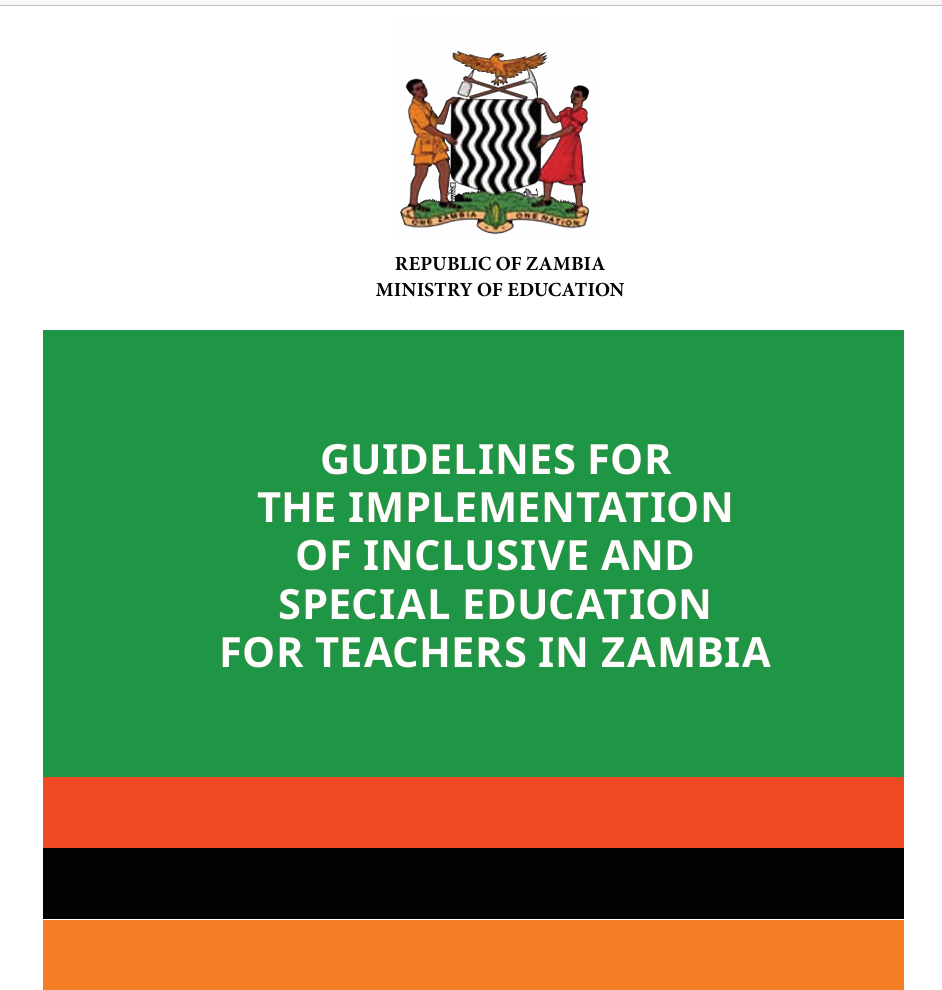
GUIDELINES FOR   THE IMPLEMENTATION   OF INCLUSIVE AND   SPECIAL EDUCATION   FOR TEACHERS IN ZAMBIA cover
Official Publication

GUIDELINES FOR THE IMPLEMENTATION OF INCLUSIVE AND SPECIAL EDUCATION FOR TEACHERS IN ZAMBIA

Directorate of Teacher Education and Specialised Services, Ministry of Education 2026

This publication by the Ministry of Education provides practical guidance to teachers and education stakeholders on implementing inclusive and special education across Zambia’s education system. It supports the Government’s commitment to Education for All by promoting equitable access to quality education and ensuring that learners with special educational needs and/or disabilities (LSEND) can access, participate in, and benefit from learning. The guidelines build on the Education Act No. 23 of 2011, the Persons with Disabilities Act No. 6 of 2012, the National Education Policy of 2025, and the Ministry of Education’s 2015 guidelines on inclusive and special education. Updated through a consultative process involving more than 600 stakeholders, the publication aims to help teachers translate national policies into effective classroom practices, provide appropriate learning support and reasonable accommodations, and create inclusive learning environments from early childhood education through secondary and tertiary levels. This resource is intended for teachers, school administrators, teacher educators, education officials, and other stakeholders working to strengthen inclusive education and improve learning outcomes for all learners in Zambia.

NATIONAL-EDUCATION-POLICY-2025 cover
Official Publication

NATIONAL-EDUCATION-POLICY-2025

Ministry of Education 2025

The National Education Policy of Zambia outlines the Government’s commitment to strengthening the education sector and advancing human capital development in line with Vision 2030. It addresses key challenges affecting education, including literacy and numeracy outcomes, access, equity, quality, infrastructure, and the integration of digital technologies and 21st-century skills. The revised policy is guided by six strategic pillars: Access and Participation, Quality, Equity, Excellence, Partnerships, and Efficiency. It provides a framework for building an inclusive, equitable, and quality education system that supports sustainable national development and aligns with regional and global education priorities, including the Sustainable Development Goals (SDGs).

Guidelines-for-managing-Secondary-schools-Final cover
Official Publication

Guidelines-for-managing-Secondary-schools-Final

Ministry of Education 2026

The Ministry of Education has developed these Secondary Education Guidelines to drive reform in Zambia's secondary education sector. Built on recommendations from the 2022 Secondary Education Symposium and stakeholder consultations, with British Council support, the guidelines provide a framework for e ective school management, covering leadership, curriculum implementation, teacher development, student welfare, infrastructure, and community engagement. Developed through key recommendations from the Secondary Education Symposium held in 2022 and extensive stakeholder consultations, with support from the British Council, these guidelines operationalise learning commitments made in the 2023 Zambia Education Curriculum. The guidelines aim to accelerate e orts to align secondary education with the 2023 Competence Based Curriculum (CBC), providing an exceptional learning experience that assists learners to transition to tertiary education, with a focus on skills acquisition that responds to socioeconomic activity. They clarify the transition from the Grade to the Form system.

Connecting Zambia with Knowledge

The Zambia Library Service supports access to reliable information resources for education, lifelong learning, research, innovation and national development.